


 LIPOELASTIC TEAM
 .png)
On warmer days, wearing compression leggings for hours can feel uncomfortably hot. Whether you’re at home, at work or enjoying gentle activity, thermal comfort can make a difference to how your leggings feel throughout the day.
This is where PCM technology comes in. Behind those three letters is a material property that allows fabric to absorb and store heat. Here’s how it works and how it becomes part of your everyday comfort in BALANCE leggings.
What Is PCM?
PCM stands for Phase Change Material: a substance that absorbs or releases heat as it changes its physical state. Think of ice melting. It takes in heat to change from solid ice into liquid water. PCMs used in textiles follow the same basic principle, with materials selected to undergo that change within a useful temperature range.
During this transition, thermal energy goes into changing the material’s state. This lets it store heat and act as a temporary thermal buffer.
How Do Tiny Capsules Absorb Heat?
In PCM textiles, tiny microcapsules can enclose the phase change material. These capsules keep the substance contained as it changes between solid and liquid.
As the material warms to its transition temperature, the PCM begins to melt, absorbing heat in the process. When conditions cool sufficiently, it solidifies and releases the stored energy. This reversible process is what makes PCM useful for managing changes in thermal comfort.
Think of the capsules as tiny, temporary heat stores. They take in thermal energy during melting and release it again during solidification.
How Does This Work in BALANCE Leggings?
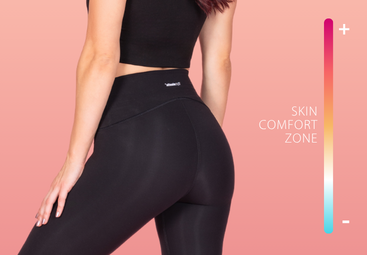
 BALANCE leggings feature the THERMALSENSE® thermoregulating finish, which uses PCM-containing microcapsules bonded to the fabric fibres. When you warm up, the PCM absorbs some of the excess heat, helping support a more comfortable feeling at the skin’s surface. The technology works passively in response to temperature, including while you are resting.
For everyday wear, the appeal is simple: compression leggings with an additional way to manage warmth.
What Does “Cooling” Mean in Practice?
With BALANCE, cooling means helping absorb excess heat. The fabric acts as a thermal buffer rather than providing powered refrigeration or heating.
The perceived effect varies from person to person. It is best understood as support for thermal comfort, rather than a promise that you will feel cold whenever you wear the leggings.
Consider the moments when warmth becomes distracting: sitting in a heated room, moving between indoor and outdoor spaces, or walking to catch a train. These are the everyday situations that make thermal comfort worth thinking about when choosing your next pair.
Comfort Beyond the Technology
BALANCE combines its thermoregulating finish with medium compression, a high comfortable waistband and soft, stretchy fabric with a matte finish. It is designed for travel, light activity and everyday wear.
If you’re new to compression, explore our article on the everyday benefits of compression leggings beyond post-op care for a broader introduction to how compression can fit into your daily routine.
Choosing your leggings also means considering what matters most to you, from the level of support to the fabric’s additional features. For BALANCE, that combination is medium compression and thermal comfort. Our guide to finding the right compression leggings for your body explores other options across the LIPOELASTIC range.
Wear BALANCE with trainers and a relaxed top for a walk, or pair them with an oversized shirt for a casual day out.
How to Care for Your BALANCE Leggings
Wash your leggings inside out at 30°C on a gentle cycle, using a mild detergent. Avoid fabric softener and bleach, and let them air dry rather than tumble drying.
Discover the Comfort of BALANCE
Your everyday leggings should feel as good as they look. BALANCE brings together heat-absorbing PCM technology, comfortable compression and a versatile design that fits into your day.
Resources:
Mondal, S. (2008). Phase change materials for smart textiles – An overview. Applied Thermal Engineering, 28(11–12), 1536–1550.
Paling, I., & Macintyre, L. (2020). Survey of lipoedema symptoms and experience with compression garments. British Journal of Community Nursing, 25(Sup4), S17–S22.





 England



 Wales
Wales
 Scotland
 Northern Ireland
 Isle of Man
